



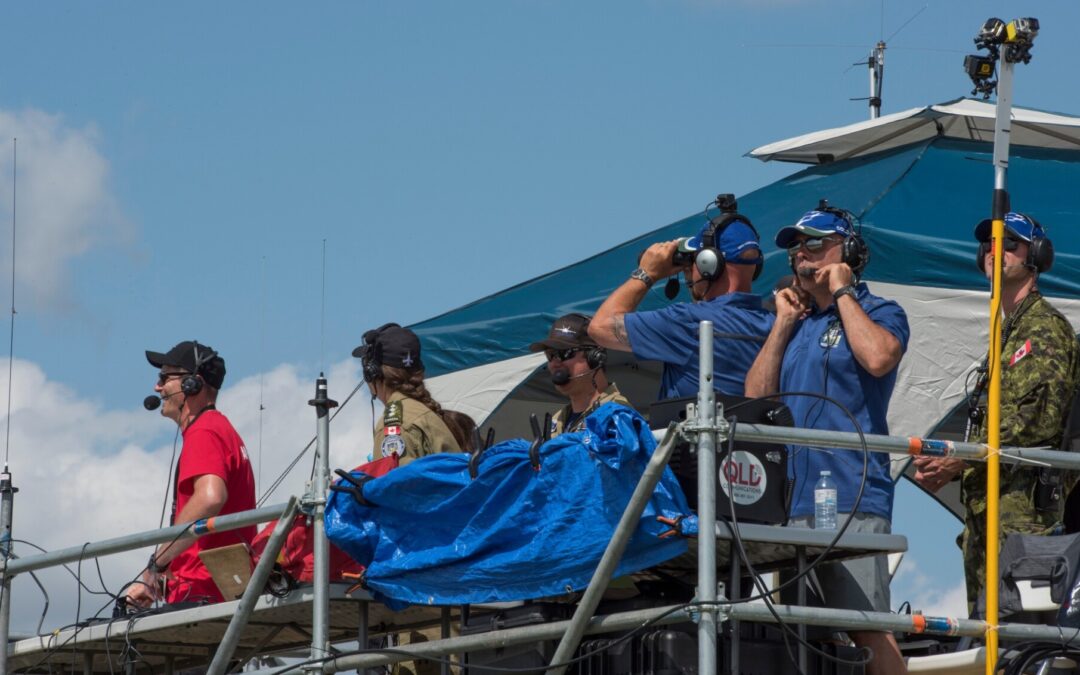
Major Erick “Hom” O’Connor (second from the right) at the 2018 Cold Lake Air Show – File Photo
Few roles at an air show are as central as that of the Air Boss. For Major Erick “Hom” O’Connor, the current Director of Air Operations for the Cold Lake Air Show and a former Air Boss for the event, the job is equal parts planner, coordinator, and conductor.
“Much of the Air Boss’s work begins months before the event,” he explains. In that early phase, the focus is on bringing together all the key stakeholders to ensure everything required to run the show is in place.
That includes coordinating “regulatory, airspace, communications, and most importantly emergency response plans,” working closely with organizations such as Transport Canada and Air Traffic Services, as well as on-field emergency teams.
As the event approaches, the planning becomes more hands-on. Maj O’Connor describes how, in the weeks leading up to showtime, “the Air Boss typically conducts a tabletop exercise to ensure all agencies are aligned and operating from the same plan.”
Once the Cold Lake Air Show opens, the role shifts entirely.
“During the air show itself, the Air Boss serves as the conductor of the event,” he says. From that position, they manage the flying schedule, coordinate each performance, and deliver daily briefings that set the tone for the day’s flying program.
Behind that structure, Maj O’Connor explains, is a level of preparation most spectators never see.
“What people see in the sky is really just the tip of the iceberg,” he says. “Behind the scenes, there are months, often years, of planning that go into making an air show happen.”
While performers are refining their routines, a large part of the work is happening on the ground. “Our team is coordinating everything from safety planning and emergency response to hiring performers, securing aircraft, managing infrastructure, and making sure the entire event runs smoothly.”
By the time aircraft begin taxiing, that groundwork is what allows the show to appear seamless to the audience. “There’s been an incredible amount of work to ensure that what the audience sees feels seamless, safe, and world-class.”
Once flying begins, the Air Boss becomes the central point of coordination in real time. Throughout the show, they remain in constant communication with performers and ground teams, keeping the entire airspace coordinated and the program moving as planned.
Aircraft movements are carefully organized well in advance. “By the time the show starts, all the deconfliction, who goes where, when, and at what altitude, has already been carefully designed, vetted, and rehearsed,” he says. During the event, aircraft are separated both geographically and vertically, allowing multiple performances to flow in sequence.
Flexibility is built into that structure. “We also build flexibility into the schedule so we can adjust without ever compromising the flow of the show,” he adds.
Even with that preparation, the job demands constant adjustment when conditions change.
“The biggest challenge is dealing with the unexpected, things like changing weather or in-flight emergencies,” Maj O’Connor says. “We plan extensively for those scenarios, but when they happen in real time, especially with 25,000 people on site, the stakes are high.”
In those moments, experience and preparation come together. “When something does come up, it’s about staying calm, adapting quickly, and always making decisions that prioritize safety first.”
Looking back on his time as Air Boss at Cold Lake, one particular show stands out.
“Our last air show was one of the most challenging we’ve ever faced,” he recalls. After years of preparation, the team had assembled what he describes as “one of the strongest lineups in North America.”
Smoky weather from nearby wildfires made flying nearly impossible for the two-day event, with a condensed flying program run on Sunday. What he remembers most, however, wasn’t the challenge itself, but how everyone responded.
“What stood out most was how our team and performers came together under pressure,” he says. “Despite the challenges, they did everything possible to deliver a great experience.”
While his role was focused on managing aircraft movements, he points to the broader team effort as the key to the show’s success. That collective work was later recognized internationally when the event received the Dick Schram Memorial Award for community relations.
“I couldn’t be more proud of how our team handled adversity with professionalism, resilience, and a smile,” he says.
The Cold Lake Air Show is pleased to be in partnership with our Hosting Sponsor, Inter Pipeline!

The preceding text was a paid endorsement for the 2026 Cold Lake Air Show.