



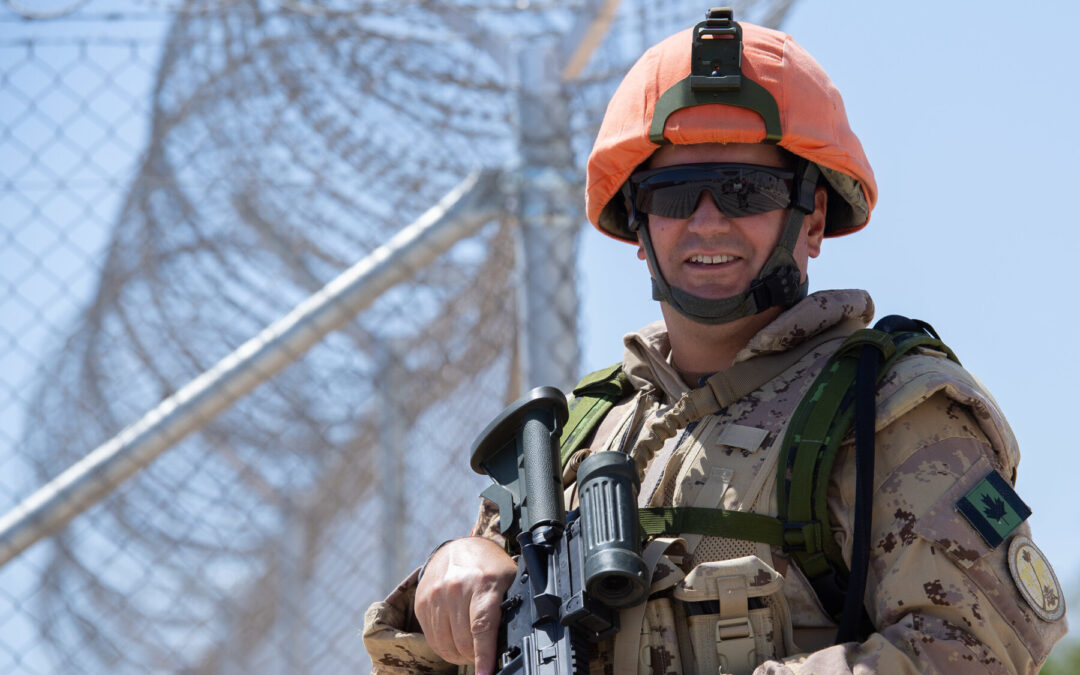
Corporal Shantz Hallman, a member of the Multinational Force and Observers (MFO), stands guard during a training exercise at the MFO South Camp in Sharm El Sheikh, Egypt during Operation CALUMET on March 27, 2019 – Photo: Sergeant Vincent Carbonneau, Canadian Forces Combat Camera
The Canadian Armed Forces (CAF) is rebalancing its international operational commitments over the next two years, closing several overseas missions and reducing its presence on another as it shifts personnel toward higher-priority defence needs.
The Department of National Defence says the changes are intended to better align CAF resources with evolving defence priorities, including defending Canada, supporting the Euro-Atlantic region, and contributing to stability in the Indo-Pacific region.
As part of the rebalancing, the CAF will conclude Operation KOBOLD in Kosovo by the end of 2026 while reducing its contribution to Operation CALUMET in the Sinai Peninsula over the same period. Operations SNOWGOOSE in Cyprus, SOPRANO in South Sudan, and CROCODILE in the Democratic Republic of the Congo will end by mid-2027.
Approximately 50 to 60 CAF members currently serving on these missions will be progressively reassigned to other operational roles at home and abroad.
According to National Defence, the changes will allow the CAF to focus its personnel and capabilities where they can have the greatest impact while maintaining readiness for emerging security challenges and continuing to work alongside allies and international partners.
Although the missions involve relatively small numbers of personnel, they are primarily staffed by experienced officers and non-commissioned members whose leadership and operational experience will strengthen other priority roles as they are reintegrated.
Operation CALUMET, Canada’s contribution to the Multinational Force and Observers in the Sinai Peninsula, will see the largest adjustment. The current Canadian contingent of approximately 40 personnel will be reduced to about 10 by the end of 2026 while continuing to provide air traffic coordination and flight information services supporting the Egypt-Israel Peace Treaty.
Operation CROCODILE currently includes approximately nine CAF members supporting the United Nations Organization Stabilization Mission in the Democratic Republic of the Congo through operations, planning, liaison, and training.
Operation KOBOLD has maintained a Canadian commitment of approximately five CAF members to the NATO-led Kosovo Force since 2008, providing logistics, headquarters support, and operational coordination.
Canada’s contribution to Operation SNOWGOOSE currently consists of one senior CAF officer serving with the United Nations Peacekeeping Force in Cyprus.
Operation SOPRANO includes approximately nine CAF members serving as staff officers and military liaison officers with the United Nations Mission in South Sudan.
National Defence said the transition will be carried out in coordination with international partners over the next two years.
While these operations are being reduced or concluded, the CAF will continue to support international peace operations through Operations PRESENCE, CALUMET, and JADE in coordination with organizations including the United Nations, NATO, and the Multinational Force and Observers. The Military Training and Cooperation Program will also continue providing pre-deployment training to troop-contributing nations through international Peace Support Training Centres.
“The service of Canadian Armed Forces members on these missions has made a real difference,” said Minister of National Defence David J. McGuinty in a statement. “As the global security environment evolves, the Canadian Armed Forces must remain ready and focused where it can have the greatest impact.”
Chief of the Defence Staff General Jennie Carignan said the changes will ensure the CAF remains prepared for future security challenges while continuing to contribute alongside allies and partners.
“Our people have made lasting contributions to peace and stability through these missions over many years,” added Major-General Tim Arsenault, Acting Commander of Canadian Joint Operations Command. “As we transition, we remain focused on ensuring the Canadian Armed Forces are ready, relevant, and positioned to meet current and future operational demands.”