



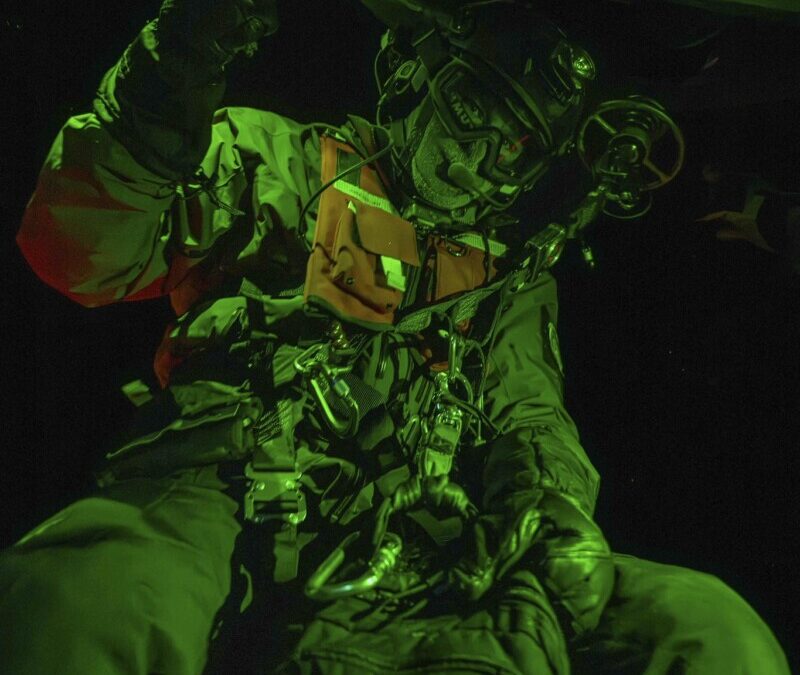
Sergeant Austin Collier, Flight Paramedic with 417 Combat Support Squadron, is hoisted back into the CH-146 Griffon helicopter during nighttime casualty evacuation training as part of Operation NANOOK-NUNALIVUT, north of Inuvik, Northwest Territories, on 03 March, 2025 – Photo: Corporal Borden Webb-Brown, Imagery Technician, 14 Wing Greenwood.
Members of 417 Combat Support Squadron from Canadian Forces Base (CFB) Cold Lake played a key role in the successful execution of Operation NANOOK-NUNALIVUT 2026 (Op NA-NU 26), the Canadian Armed Forces’ largest and most comprehensive winter operation in the Arctic to date.
Conducted from February to April 2026 under the broader Operation NANOOK framework, Op NA-NU 26 brought together approximately 1,300 CAF personnel, supported by nearly 200 vehicles and pieces of equipment, including two M777 howitzers. Operations spanned a vast geographic area, including the Yukon, Northwest Territories, Nunavut, British Columbia, Alberta, and Manitoba.
As part of the effort, 417 Combat Support Squadron personnel worked alongside Regular and Reserve Force members from across the CAF, contributing to land, air, and joint operations designed to strengthen Canada’s ability to operate in the Arctic. Members were joined by military partners from Belgium, Denmark, France, and the United States.
Throughout the operation, personnel conducted a range of activities, including complex logistics movements, equipment testing in extreme winter conditions, and a long-range patrol covering more than 5,000 kilometres from Inuvik, Northwest Territories, to Churchill, Manitoba. Canadian Rangers also played an integral role, contributing their deep knowledge of the land and supporting operations in remote areas.
Op NA-NU 26 also aligned with Canada’s contribution to the North Atlantic Treaty Organization’s enhanced vigilance efforts under Activity ARCTIC SENTRY. This initiative brings together Arctic-focused operations, exercises, and activities under a unified approach, enhancing coordination with NATO allies and improving collective awareness across the region.
Lieutenant-General Steve Boivin, Commander of Canadian Joint Operations Command, highlighted the significance of the operation.
“Operation NANOOK-NUNALIVUT 2026 demonstrated the Canadian Armed Forces’ ability to project, sustain, and command combat-capable forces across vast distances in some of the world’s most demanding operating environments,” he said. “Through this operation, our personnel operated seamlessly with allies, partners, and Northern communities to strengthen Canada’s Arctic defence posture and reinforce our capacity to detect, deter, and respond to threats in the North.”
In addition to 417 Combat Support Squadron from Cold Lake, participating units included Joint Task Force North, elements of 3rd Canadian Division and 1 Canadian Mechanized Brigade Group, the 1st Regiment Royal Canadian Horse Artillery, Primary Reserve units from 38 and 41 Canadian Brigade Groups, the 1st Canadian Ranger Patrol Group, as well as 439 Combat Support Squadron from Bagotville, 440 Transport Squadron from Yellowknife, and 450 Tactical Helicopter Squadron from Petawawa.